
History of Our Group
1941 to 1945
The Scout group was initially started during 1941 by the Reverend Thomas Gill Leech. He invited boys from the local community to become Sea Scouts and through his leadership soon had an enthusiastic following.
The group was registered with the local Scout Association in 1942, by the Reverend which he led until 1949. The Reverend affectionately known as Tommy, lived with his wife Joan (nee ??) and son Christopher (born 1940) at Glebe House. This became the new Vicarage for St John the Baptist Church in Great Amwell, Hertfordshire
Although it is still unknown why Tommy Leech opted for a Sea Scout Group, we do know that he liked all seafaring activities. Perhaps he or his father had previous naval connections. He took a lot of pleasure in teaching Scouts all about seamanship, the traditional boson's pipes and sea shanties. He also specialised in telling camp fire yarns. Tommy was a keen scout from his earlier days and the family still have old photos of him at Gilwell as a younger man and also at the 5th World Jamboree in Holland (31-07-1937).
Even though the Reverend ran the group, the Gilwell registration and census returns for 31 March 1943 show that the Group was not affiliated or sponsored by the Church. The document identifies that they owned a 10ft dinghy with stepped mast which was recorded as in working order.
The group had 25 members, comprising of:
| Wolf Cubs | Sea Scouts | Scouters | Total | |
| Under 14 | 8 | 10 | 18 | |
| 14 - 20 | 5 | 1 | 6 | |
| Over 20 | 1 | 1 | ||
| Total | 8 | 15 | 2 | 25 |
Some of the original 1941 Sea Scouts are listed below:
Alan Osborne, Alan Parker, Alan Reynolds, Brian Taylor, Bryan Bull, David Harradine, David Marques, Geoff Bunn, Gordon Sanders, John Atkins, John Ironside, Kenneth Jennings, Kenneth Parker, Michael Bland, Michael Jennings, Michael Willbourne, Norman Gadd (PL), Norman Vines, Peter Cottrell, Richard Sidey and Tony De Lozey
The Troop originally met in the Vicar's room which was located just inside the field on the east side of the Church Rectory off Hillside Lane, Great Amwell. The room was made of wood and had a cast iron wood burning or coke stove in the middle of what was basically a single room; but may have had a small room on one end. At the north end, there was a small raised stage area, under which was stored scout equipment.
Most boys cycled or walked to scout meetings, returning home on dark evenings in groups as wartime blackout restrictions applied. Petrol rationing and war time restrictions meant that there was very little vehicle traffic on the roads especially at night.
The Sea Scouts regularly camped in Glebe fields
(SG12 9SF) adjacent to the Vicar's room. Here they
made full use of a spinney (a copse that shelters game) in the
middle of the field for cooking and camp fires.
Scouts regularly attended St. John's Church, Great Amwell, but not always as a uniformed group. Some Scouts were members of the Church choir and others would attend service after joining the Sunday morning cooked breakfast in the Vicar's Room.
The Troop was originally made up of two patrols, Bulldogs and
Seagulls lead by patrol leaders
Alan
Reynolds and Michael Jennings. As the Troop expanded over the next
few years a third patrol,
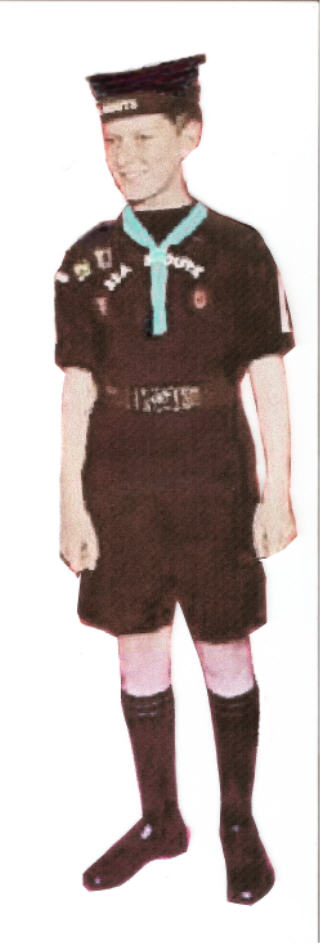
Boys wore the traditional Sea Scout uniform which was a dark blue woollen jumper, shorts and a navy style hat. Their neckerchief for Great Amwell Sea Scouts was light blue.
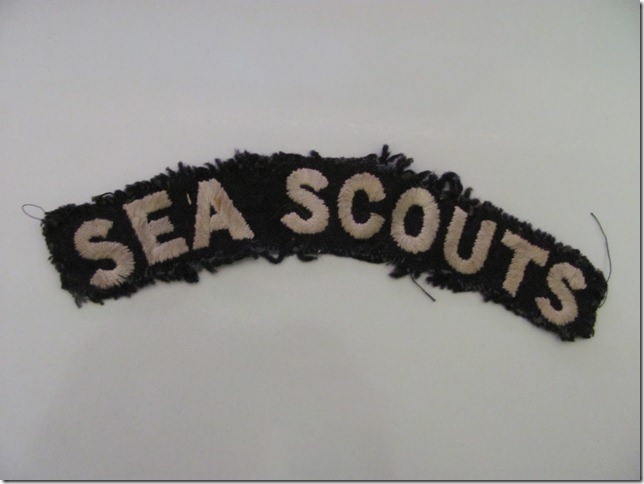 On
the front of their dark blue jersey, they had the Sea Scout badge.
On
the front of their dark blue jersey, they had the Sea Scout badge.
Scouts within the village were not evacuated during the War period and meetings continued throughout. An army sergeant nicknamed 'Socks' who was posted to a local searchlight unit opposite to where Lower Road joins the A1170, took on the role of an assistant Scout leader in the troop. He is thought to have come from Southend and was a Scouter in peacetime. He became very involved with troop activities such as wide games and was extremely popular with the boys.
In 1943 and 1944, the Patrol Leaders and Seconds camped at Latchford Farm, Latchford, Standon, Ware (SG11 1QZ) for 4 days over the Easter Holidays.
During 1943, one of our Sea Scouts (Michael Jennings) attended a one week Seamanship course on the RRS Discovery moored at Temple Pier on the Thames embankment. The RRS Discovery was constructed specifically for Antarctic expedition and polar research and became a memorial to Captain Scott. Between October 1937 and June 1954, it became the main Headquarters and training ship for the Sea Scouts. In 1944 Brain Bull, Geoff Bunn and Norman Gadd also completed their one week Seamanship course held on the RRS Discovery.
In August 1942 and 1943 Scouts cycled from Great Amwell to Much Hadham for their annual summer camp. Their personal gear and camping equipment was transported to the site in Mr Murphy’s furniture van.
Tony Burgess can remember being invited to join the Sea Scouts in mid to late 1944, by his close friends, Michael and Kenneth Jennings who were already keen members. Tony lived in Viaduct road, just by the entrance to the flower mill. At the time he was a 3rd Ware Scout, meeting in Amwell End, but made the transfer to Amwell Sea Scouts.
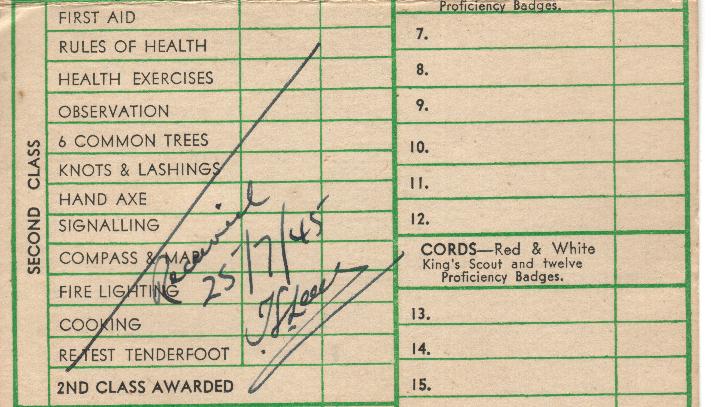
Over the next few years, Tony passed his Tenderfoot and Second Class (25 July 1945), both of which were signed off by “Skip” Leech (see below). Skip or Skipper, was the traditional name for a Scoutmaster. Akela, being the traditional name for Cubmistress or Cubmaster (from The Jungle Book).
He was also working towards his First Class and had already gained a number of proficiency badges. There was always an incentive within the Troop, to get as many badges as possible display on their scout jumpers.
As with Scouts of today, boys enjoyed outdoor activities, especially sleepovers and camping. Boys spent a lot of time, usually during weekends at Concrete Utilities Ltd (CU Phosco Lighting Ltd), founded and run by Major Charles Albert Marques, whose son David Marques was a member of the troop. Major Marques fought in the 1914 -1918 war, and in 1939 turned over much of his land around the factory into training areas for the Home Guard with firing range included. The site also provided storage for a large number of military vehicles including a lot of ambulances. Major Marques lost an eye in the 1st World War and won a medal, saving the life of man who had “frozen” when he was about to throw a hand grenade.
Our Scouts were allowed to use the ambulances for weekend sleepovers and would then explore the land around the site. There was an extensive narrow gauge railway system, numerous gravel pit ponds and a large disused swimming pool. Concrete Utilities also had an excellent canteen, on the south side of the complex and close to the field where the ambulances were stored. They served great sausage sandwiches which always went down well with the Scouts.
John Atkins, who was Tony Burgess school friend (Hertford Grammar School) and a fellow Scout, lived close to the Concrete Utilities premises. His father was a nurseryman, and his house was on the Ware side of the main factory entrance, the end house of a block of semi-detached or block of four. At the weekends, they used to play on the narrow-gauge railway pushing the small trucks then jumping on. Tony clearly remembers the day when John fell off and cut his knee on a rusty rail. After putting his handkerchief over the cut, they both carried on playing. Later the wound turned septic and he was bedridden for a long while, living in the front garden in one of the army ambulances.
Tony Burgess can remember John Colville's father who was a local Doctor, dropping off a number of scouts in his smart "Foyle’s War" TV look-a-like car. It was a bit of a scary ride home, with blackouts, no street or car headlights allowed. Having just dropped off John Atkins half way along Lower Road, the doctor was fast approaching the sharp bend and narrow humped bridge over the New River. Being on a road unfamiliar to the doctor and with scouts shouting directions from the back seats, his car nearly ended up in the river. [Kelly’s Directory 1937, Hertfordshire page 280, lists the doctor as Jas. Robertson Colville, 63 High Street, Ware.]
Michael Jennings remembers a ‘Lifeboat' with cloth sail, although it couldn’t be used as there were no oars or rowlocks fitted. Funding at the time was very limited and remedial work to convert into a rowing boat was not possible. The group also had a 12ft wooden rowing dinghy, which could hold 3 persons e.g. skipper and 2 patrol leaders. The Revd Thomas Leech, Michael Jennings, Alan Reynolds set out during their 1947 summer holidays, to row from Ware to Bishop’s Stortford along the River Lea and River Stort. Due to drought restrictions which prohibited the passage through the locks this took longer than expected. Having to carry their boat around each lock, meant that they got no further than the village of Roydon. There they spent two nights resting and camping near to the Glen Faba campsite (CM19 5EX), before rowing back to Ware.
Tony Burgess constructed his own kayak using plans purchased from the Scout Association. He covered the wooden frame with a second hand railway tarpaulin which was then painted with green tar paint (tar with linseed oil). He remembers spending many happy hours on the River Lea, which was especially fun at night calling out from under the Ware Bridge
During the summer of 1945 (Monday 13 August 1945 to Wednesday 22 August 1945), the Sea Scout Troop including Norman Vines, Michael Jennings, Alan Reynolds, Tony Burgess and John Ironside camped between Gillingham and Beccles in Suffolk. Two patrols went by train via Liverpool Street, loading all their gear into the Guards van. Reg Jennings who was Michael's father, also attended the camp as their Honorary Quarter Master. Tony remembers being transported with their kit to and from the railway station to the campsite in an old cattle lorry. Although it had been hosed out, it still gave off a strong animal odour and everyone was pleased not to be travelling inside for any long distance. The camp was on the Gillingham side of the river Waveney, about 100 yards up a slope from the river bank. They used a borrowed dingy to cross over the river and would frequently walk along the tow path into Beccles.
On the 15 August 1945 during their camp, "V J Day" was proclaimed when Japan surrendered. Scouts were invited to attend the end of war celebrations at Beccles. Tony remembers missing the "V E Day" celebrations on 8 May 1945, when Germany surrendered, because he was in bed with chickenpox.
Some of the Scouts went for a day trip to Lowestoft (Monday 20 August 1945). The town's Claremont pier had been sectioned during the War for fear of invasion. Once danger had passed, the sections were rejoined using Bailey bridges. At the time of the visit, the pier was being used by the army as a training centre. Because the Sea Scouts wore their full uniform including sailor's hats, they got through the pier turnstile free of charge as members of the armed forces even though most of them were only aged between 11 and 15 years.
In 1945 two of our Sea Scouts were awarded their King’s Scout Badge, the most prestigious award of the time. The King’s Scout or Queen’s Scout badge was awarded to scouts who prove themselves able and willing to server the reigning monarchs of England (King George VI 1936 – 1952, Queen Elizabeth II 1952 – 2022, King Charles III 2022 – present).
The Reverend Tommy Leech was always very busy with his local parish congregation, the demands of his new Sea Scout group and young family life. In 1945, he expanded his remit by becoming the Founder President (1945/46/47) of the Rotary Club of Ware which received its Charter on 13th March 1946 as No. 6169.
1946 to 1959
The 1946 summer camp was once again at Beccles but this year extended to a fortnight. Scouts travelled by train via Liverpool Street on Wednesday 7 August 1946, returning Wednesday 21 August 1946. Tony Burgess was on a week's family holiday in Skegness, but was very keen to join the camp. His parents dropped him off on their homeward journey at Peterborough (or March) station on Saturday 10 August 1946 so that he could take the train via Norwich to Beccles. Tony was a keen train spotter, so travelling alone gave him a good opportunity to record the details of passing trains on his journey.
Camp activities including badge work, patrol challenges and water activities such as swimming across the river to gain points for their patrol. On one occasion Tony recalls getting cramp and having to be rescued by his fellow scouts. On Sunday mornings the Sea Scouts would attend the Church parade at Gillingham.
Tony Burgess can remember a day trip to Yarmouth or Lowestoft on Friday 16 August 1946, calling in at “Pop’s Kipper Snack Bar” on the sea front. The café only served fresh kippers with bread and butter and a big mug of tea. He fondly remembers going back for more of the fantastic kippers.
Scouts regularly took part in District events and won their first two competitions in 1947. The first being the British Legion Shield awarded to the team who won the annual Camping Competition. This was soon followed by the Scout Trophy, an annual award for Scout Troops displaying all round achievements. The Wolf Cubs won their first event in 1949 taking the Oxley shield from their 3rd Ware colleagues.
In March 1948 the Assistant County Commissioner for Scouts, Dr L R
Pears, presented the Reverend T. G. Leech
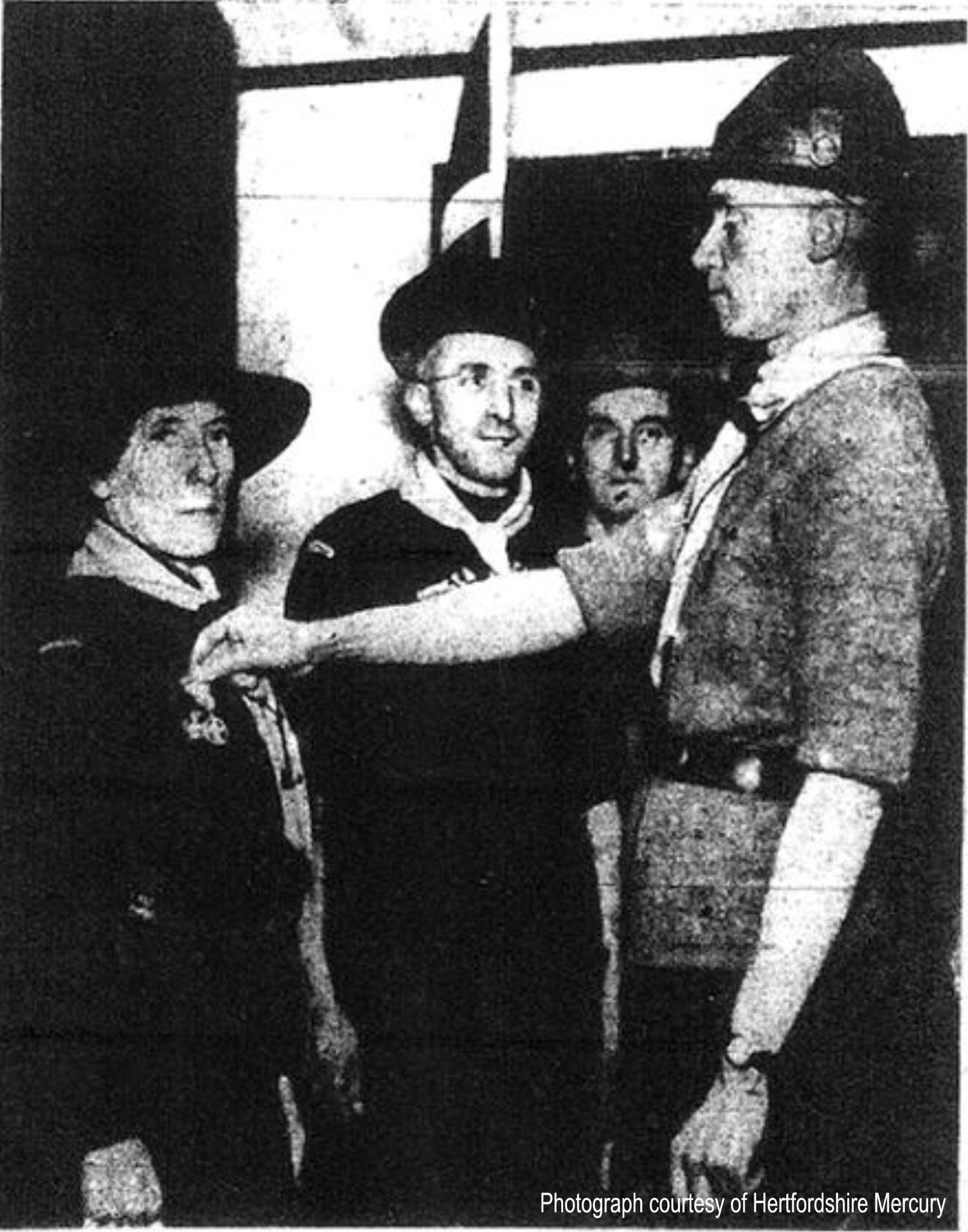 (now
the Group
Scout Leader) and Mrs Hilda Warren, Great Amwell Cub Mistress and
Assistant District Commissioner (Cubs) with their
Medal of Merit for
distinguished service to the Boy Scout Movement (only completed 7 years
scouting service). (Photograph
courtesy of Hertfordshire Mercury)
(now
the Group
Scout Leader) and Mrs Hilda Warren, Great Amwell Cub Mistress and
Assistant District Commissioner (Cubs) with their
Medal of Merit for
distinguished service to the Boy Scout Movement (only completed 7 years
scouting service). (Photograph
courtesy of Hertfordshire Mercury)
The following year the Reverend T. G. Leech left Great Amwell Church and moved to Hertingfordbury where Tommy Leech became the Rector of St. Mary's Church. This was to become his last Parish before the family moved to Canterbury to live with his sister in-law's (Kathleen Harding) family.
In 1951 the family move to Ramsgate where he became the Rector at Holy Trinity, East Cliff (1951 to 1961/2). He was also the Priest in Charge at St Pauls Church (1951 to 1957/8). St Pauls church had been closed in July 1940 along with other parish churches in the area while hostilities continued. Although the church remained undamaged throughout the War, the surrounding area was badly damaged in an air raid on 12th November 1940, After the War the Church remained closed and was eventually demolished in January 1959. John Ironside can also remember Tommy Leech becoming a Chaplain of a local lightvessel (possibly the LV81 Lightvessel located to the north end of the Goodwin Sands and close to the resorts of Margate and Ramsgate). During his visits John Ironside accompanying Tommy to the lightvessel where the gave a short service and blessing on board (See LV81 lightvessel link, which shows a photograph of a vicar giving a service and blessing onboard this lightvessel. This may have been the Rev Tommy Leech).
Soon after becoming the rector of Holy Trinity Church in Ramsgate, he reinstated the Holy Trinity Sea Scouts [6th Ramsgate Sea Scout Group]. His son Christopher Thomas Gill Leech (1940-2012), was a Sea Scout and eventually became Patrol Leader of the Seagulls. Later to gained an MBE for services to British education in Spain (June 2006)
One of Tommy Leech's original Sea Scouts, Kenneth Jennings, worked alongside him in Ramsgate as Curate (1958 -1961), after finishing National Service and completing his Theological studies. Kenneth was later to become the Dean of Gloucester. John Ironside also followed a similar path after finishing National Service, completing his Theological studies and taking up a career in the Church.
Recent research has found that the Reverend Thomas Gill Leech returned to St Mary's Church, Hertingfordbury in 1968 (previously Vicar in 1949-1950). A service for the Institution by the Right Reverend the Lord Bishop of St Albans and induction by the Venerable the Archdeacon of St Albans was held in September 1968. Tommy Leech died in 1988, where he was recorded to be living in Canterbury.
In September 1949, the Commissioner for Sea Scouts, Lieutenant Commander
Horace Taylor, G.C MBE visited Great Amwell Sea Scouts for a
group inspection. Joining him was Mr L. P Thompson - Mc.Cau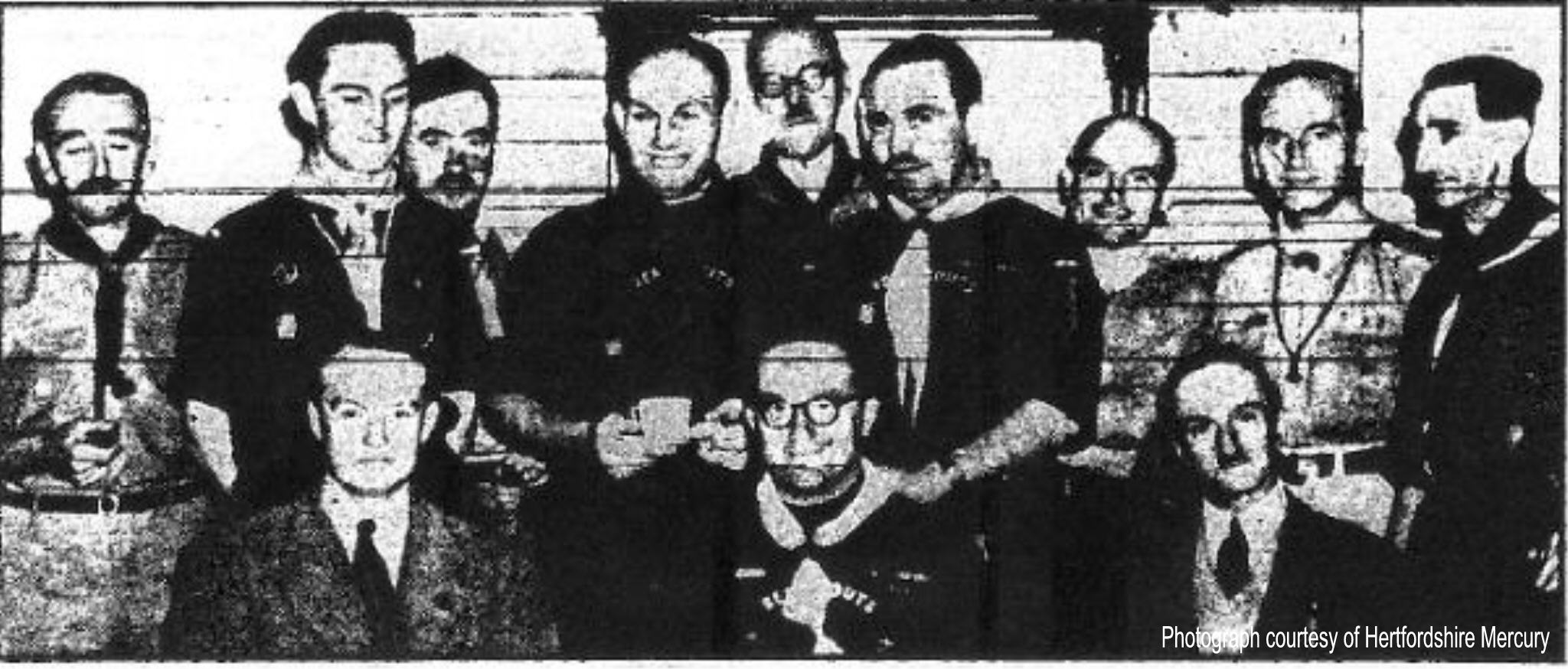 sland,
president of Ware and District Local Scouts Association, and Captain
W H Ricketts, a member of Great Amwell Sea Scouts’ Committee.
sland,
president of Ware and District Local Scouts Association, and Captain
W H Ricketts, a member of Great Amwell Sea Scouts’ Committee.
Click on picture to view other attendee names. (Photograph courtesy of Hertfordshire Mercury)
Lieutenant Commander William Horace Taylor: Born on 23rd October 1908, a former pupil of Manchester Grammar School was one of several Manchurians' who were awarded the George Cross. Taylor was a bomb disposal engineer and was given the award for work done in disposal of mines in September and October 1940. He had worked at Manchester Docks (now Salford Quays) and had joined the Admiralty at the outbreak of war in 1939. He suffered from many bomb blasts, but survived them all and spent his post-war years as a Travelling Commissioner for the Sea Scouts. From 1953 to 1973 he was Scouting Association's Field Commissioner for Southwest England, and became a property manager in Glasgow. He died on 16th January 1999 at the age of 90. He had also been awarded the MBE
Captain W H Ricketts attended the Prince of Wales Training School (Merchant Navy) and in the early years of his career served time on the SS Beltana and Arundel Castle. Both ships were large and SS Beltana served as an Imperial and Australian troop transport during the 1914 -1918 War. Arundel Castle was requisitioned as troopships in WWII on worldwide convoy routes, including one of the first convoys to get through the Mediterranean. Beltana was scrapped in 1933 and Arundel Castle scrapped in 1958. The Ricketts family served on the committee and were also involved with leading the Cubs in 1957. It may have been through Captain Ricketts naval connections that we owned a ship’s “Life Boat” originally mentioned by Michael Jennings.
The Sea Scout Leader photographed standing in the centre with cup and saucer is the Revd Edward C. Walker who took over from the Rev Tommy Leech as GSL. In later life he conducted the Service of Dedication at the opening of our new Wooden Scout HQ in 1979.
After the War, the Sea Scouts frequently used the 12ft wooden rowing dinghy on the river Lea. An entry in the troop accounts shows a payment of £1 to the Hardmead lock keeper (September 1958) for passages through the various locks. The craft was stored in a boat-house at the back of Mr Reg Jenning's High Street printing establishment (no. 43/45) in Ware. Mr Reg Jennings and his sons (Michael and Kenneth) were members of Great Amwell Sea Scouts, until his two sons were call up to complete their compulsory 2 years National Service (1947-49 & 1950-51).
The Sea Scouts had a winning streak in the Camping Competition during the 1950s winning the British Legion Shield six times (1952, 1953, 1955, 1956, 1957 and 1958). In 1958, during an award ceremony attended by Dr L Pears (County Commissioner), Mr H Sharp president of the Ware British Legion presented 14-year-old Seagull Patrol Leader Peter Pawsey, with the shield. The competition included a ten mile journey on which the Scouts had to cook all their own food, practice map and compass work and complete a logbook, giving descriptions of the countryside through which they passed.
Historical records identify that some repairs were carried out on the boat–house in 1958, sufficient to see it through the winter with roof repairs being carried out in the following spring. In November 1958, a boat was sold to Hertford Sea Scouts, with proceeds being put towards funding for a new patrol tent.
Throughout 1957/ 58 the
Group committee
were actively engaged in looking for their own
permanent Scout hut in and around Great Amwell. A number of
sites were
initially
identified, one being at the lower end of
the paddock below "Home Lodge" and "Walton Lodge". Another being
a semi-derelict building known as the "Homestead", just behind "Philmer"
cottage both in Amwell village. Also,
a plot of land near to the cricket field at
St Margarets-bury.
At this time the committee were very busy fundraising for their new Scouts hut venture, with regular 'Whist' drives and raffles. The Scouts and Cubs were also occupied in fundraising for new camp equipment and raised £16-9s-9d during one of their annual Bob-a-Job village tasks. The first Scout Bob-a-Job week was held in1949, but ceased in 1992 due to health and safety restrictions.
Scouts met on Monday with Cubs on Tuesday evenings to fall in line
with their leader’s availability. The Cub pack was so short of
leaders that they eventually ceased regular weekly meetings.
The Troop suffered an unexpected setback in August 1959, when their hard pressed young Scout leader and assistant had to resign due to family and college commitments. At the time young leaders were in short supply with most ex-Scouts engaged in completing their compulsory two years National Service duties. In October, with no new leaders coming forward, the District Commissioner (Mr J McNaughten) had no alternative but to temporarily close the group. All remaining Scouts were transferred to other local Ware and District groups. The District Commissioner, in a letter to the Group Chairman said:
“I do so, like you, look forward
to the day,
1960 to 1980
It was not too long to wait and a few months later in 1960, the process of re-opening the group was once again started.
In the registration document submitted to Gilwell in December 1960, showed that the Groups name had been changed from "Great Amwell Sea Scouts" to "Great Amwell Scouts". The document also recorded that, 10 Wolf Cubs were already regularly meeting at the school in Great Amwell. Mr William Henry Berry was recorded as the Cub Master along with his wife Olive as his assistant both living in the local area. Their son David was of Wolf Cub age and having spoken to the family, was the main reason why William and Olive volunteered to help re-started the local group.
The group soon move to a small open plot of land on the corner of Gypsy Lane at the intersection with Amwell Hill (A1170). The site had no indoor facilities and therefore during the winter months or in bad weather, the Cub pack would meet indoors at the William and Olive's home nearby.
Cub Scouts and Scouts wore the traditional land Scout uniform,
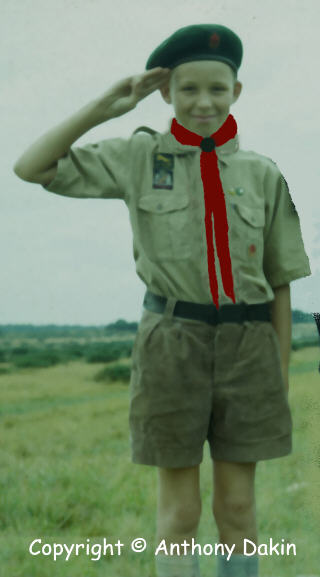 with
a plain Scarlet neckerchief, chosen by William and Olive Berry when the
group was re-opened.
with
a plain Scarlet neckerchief, chosen by William and Olive Berry when the
group was re-opened.
Sometime during 1961 the group
moved to a new location on the southern outskirts
of Ware and met in a very small old timber hut. This hut was known
by
locals as the “Kenya Coffee
House”
with
this name displayed on the front for many years.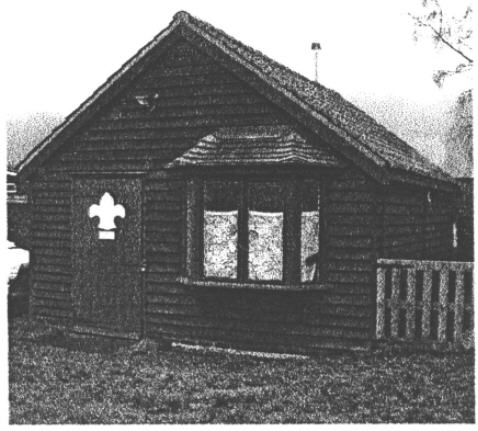
The hut along with a large house and surrounding land in Postwood belonged to Captain Richardson and his family. They also owned a large estate in Kenya where coffee was grown. The hut was used to store and roast coffee beans, and distribute coffee and tea to the local area. As a toddler in the 1940s and early 1950s, Jean Glasscock can remember the smell of roasting coffee as her granny pushed her past the "Coffee Hut" on her afternoon walk. Jean had never tasted real coffee as the family could only afford Camp coffee and Chicory Essence at home, which was a liquid Cofee in a bottle.
The 'Kinjar’ hut continues to be well maintained to its 1950 / 60s style and is use to store our Scout equipment
William Berry (1917 to 24 May1989) was born at 'Red House' on Ware Road almost opposite the Kinjar hut. The house where William's father worked, was later demolished, but the base can still be seen alongside the New River close to where the swans and ducks congregate today.
A peppercorn rent was paid to the Captain Richardson, the local landowner for the use of the Kinjar hut. The hut was very basic with only one electric light bulb and a small cast iron gas fire ring for heating during the winter period.
In 1963, William Berry reinstated the Scout Troop and became the Scout Master. His wife Olive was promoted to Cub Mistress. It is assumed that the ten original Wolf Cubs were reaching the upper age limit and needed to move onto Scouts.
In May 1963, records show that there were 12 Cubs and 6 Scouts regularly attending meetings.
In 1964, the Cubs were presented with the "Perowne" Cup as overall winners of the Cub sports competition. The cup was named after Canon C Perowne, who was associated with Standon Church in the 1950's and who had also been an Assistant District Commisioner in Barnet & Potters Bar.
William and Olive took eight
Scouts over to Guernsey
in July 1966 for their summer camp. Activities included a visit to a
local museum, pottery
display
and day excursions to
Hern, and Sark by boat.
I
As part of the modernisation, adult leader roles were changed. Scoutmaster, Cubmaster, Cubmistress were dropped and all adult section/group volunteers became know as leaders e.g. Group Scout Leader (GSL), Scout Leader (SL) Assistant Cub Leader (ACL) etc.
A new award and badge system was also introduced.
In 1967, Mr. P.L. Josey
(District Commissioner) initiated an “Advance Party Report” to help
modernise Scouting in Ware and District. Scouting in the past had
not moved with the times but the Advance Party Report had set out
the methods by which Scouting could be improved and brought up to
date. Rural Scouting often suffered because Villages could not find
support for a full Group. They could support a Troop of Scouts or a
Six of Cubs with an H.Q. in a central village where full Group
Meetings could he held occasionally. This report identified the
following:
Buntingford now had two Groups, one with only Cubs and the
other with only Scouts - these cries out for amalgamation. In
December 1969, it was reported the Buntingford School Scout Group
had disbanded and a new group based on the old Cub pack and new
Scout troop had been formed.
Braughing had an excellent Group. but they lack a
suitable Headquarters. It was hoped that something could be found,
say in Puckeridge, which could bring in support from Puckeridge and
Standon.
Wareside a small village with few boys of the right
age, has a small Group with its own H.Q. A District Scoutmaster is
being appointed who will be given the task of helping to put the
Group on its feet. Sadly, the group was disbanded in the spring of
1968
Stanstead Abbotts & St. Margaret’s Group is very successful and has its own new
headquarters, but it must look to its programme and ensure that it
maintains interest and keeps the boys. District events were not very
numerous but they were often not well supported. There are many
County Events also in which the District should take a bigger part.
An Assistant District Commissioner for Leader Training is to be
appointed.
Great Amwell Group is quite good but has a poor H.Q. The
Group Council want to go over to Sea Scouting. A boat is available
and other people have offered to bring boats along.
In Ware its initial proposals were that the 1st,
2nd and 3rd Ware Groups would amalgamate.
Initial proposals were that 1st Ware H.Q. (Congregational
Yard Rooms, High Street, Ware) would be used for Scouts and 2nd
Ware HQ (Church Street, Ware) for
Cubs. This was later changed to only 1st
and 3rd Ware groups being amalgamated, when 2nd
Ware was challenged to increase numbers to 4 Scout Patrols (6 in
each) by October 1967. This they achieved and therefore 2nd
Ware remained at their HQ in Church Street, while 1st and
3rd Ware joined together and used 3rd Ware HQ
in the Bluecoat Yard, Ware Herts.
A Scouters Council Meeting
had agreed that a Venture Scout Troop should be formed. This was
implemented in 1968, using the old 1st
Ware H.Q. (Congregational Yard Rooms, High
Street, Ware). In April 1970, Mr. Rob Wilkinson reported that the
new Venture Group would be named Lygean Ware Venture Group and was
being officially registered at headquarters.
Throughout the early 60’s, funds had been very sparse and in 1968 a newly formed parents and friends committee was set up under the chairmanship of Norman Bush. Thomas Dakin a Scout parent and work colleague was approached to take over the roll of treasurer. Other members of the group included Mr & Mrs Portlock, Mr & Mrs Burton, Mr & Mrs Charles, Mrs Easter, Mrs Jan Bush and Mrs Dakin (see full list under the committee members section). The new enthusiastic committee organised many fund raising functions throughout the years, with the key object of expanding the group, providing more finances and procuring better facilities. Norman Bush led the committee for four years and without his personal intervention, forward planning and commitment would have surely led to the demise of our group.
Fund raising events such as
Summer Fetes at Ware Priory, annual New Year's Eve Dances, Hoe
Downs at Ware College, Fish and Chip Suppers,
monthly
Jumble Sales and
Christmas Fairs at the Ware Drill Hall, Raffles and Car Cleaning
events, were all well attended and proved to be very successful. Captain Richardson always took a keen interest in these
endeavours and often attended the social events with his wife.
As well as fundraising, the committee were
actively looking for a larger plot of land to accommodate one of the
numerous second hand buildings that they were being
freely
offered.
Boys were participating in sporting events, swimming gala's, raft races, pioneering and aerial runways and numerous weekend camps in in the local woods. They also helped out at all fundraising events run by the Group.
Anthony Dakin can remember as a Scout, taking part in many St Georges day parades to St John the Baptist Church in Great Amwell. On one occasion, the leaders underestimated the time it would take to march the half mile along Madgeway’s and Catherley Lanes and arrived at the Church after the service had begun. As you can imagine the Vicar and parents were not too please and the Scouts were very embarrassed. Up until 2009 we had not repeated the exercise, but instead had participated in joint St Georges Day and Remembrance Day services and parades in Ware. In 2009, after over 35 years the group once again returned to St John the Baptist Church for their Remembrance Day Service and wreath laying ceremony. This is now an annual occurrence which links us back with the village where the Troop started its Scouting journey during 1941.
Scouts also remembers frequent sleepovers in Post Wood, an ancient semi-natural woodland, close to our scout hut. William Berry (Skip) would allow us to sleepover either in tents or bivvy shelters made of wooden brances and covered in bracken. Scouts always enjoyed building a large areal runway on the hillside, between two large oak trees. All activities normally went without incidents, until one Friday evening in 1968. Skip was helping strip down the areal runway and had climbed up into the big oak tree at the top of the hill. It was dusk and we suddenly heard Skip falling through the branches, hitting the ground with a thud and rolling down the steep hill. Using our First Aid skills, we made him confortable and concluded he had cracked a few ribs. Somehow we got him back to the Kinjar hut (maybe on an improvised stretcher), where one of the scouts had already gone ahead to call for and ambulance from a local phone box. One of the leasons scout learnt from this incident, was to not let middle aged Scout leaders climb trees!
While Skip was recovering, Lesley Greenwood (ADC) kindly volunteer to run scout meetings for the next few weeks.
The troop also enter the annual River Lea Raft Race between Hertford
lock and the Maltings downstream from Ware bridge. The event started in the 1960’s and
was organised by
Hertford and District 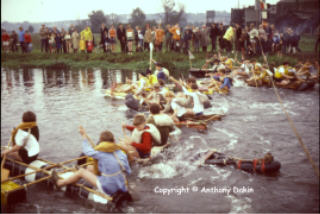 Scouts.
The rafts including handmade paddles were assembled by Hertford
lock. Available Scouts were
positioned at changeover point’s downstream ready for their turn at
the paddles. Rafts were carried around Ware lock before the final
leg to the Maltings in Star Street. In
the photo below, Anthony Dakin (red jumper) and David Berry can be
seen at Hertford lock at the start of the race.
Scouts.
The rafts including handmade paddles were assembled by Hertford
lock. Available Scouts were
positioned at changeover point’s downstream ready for their turn at
the paddles. Rafts were carried around Ware lock before the final
leg to the Maltings in Star Street. In
the photo below, Anthony Dakin (red jumper) and David Berry can be
seen at Hertford lock at the start of the race.
In 1968, Anthony Dakin and David Berry used three car inner tubes ti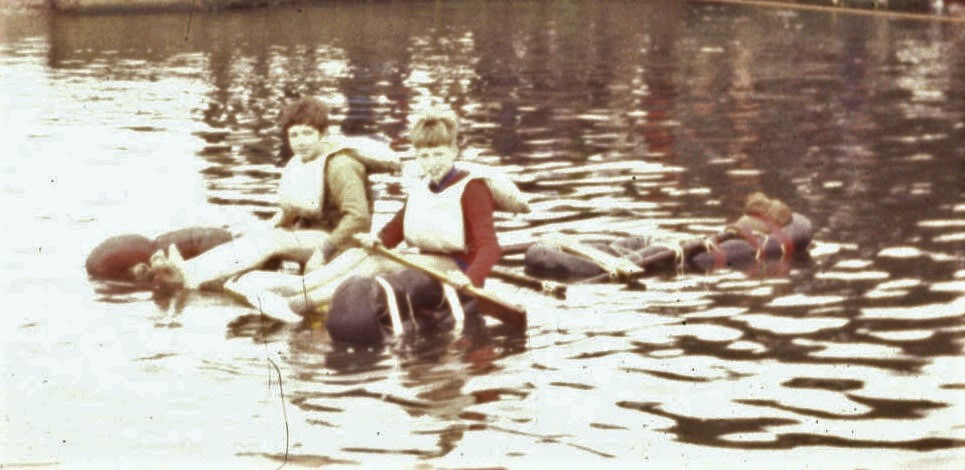 ed
to an 'A' frame and two handmade plywood paddles to cover the 3 mile raft
race.
ed
to an 'A' frame and two handmade plywood paddles to cover the 3 mile raft
race.
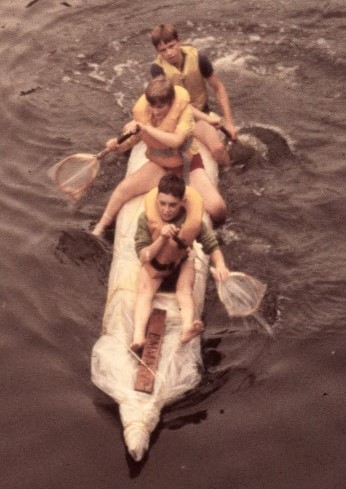
In 1969, barrels lashed together and covered in
 plastic
with old tennis rackets covered with plastic bags performed well
over the same distance. The raft was larger, allowing 3 scouts led
by Anthony to power the raft downstream.
plastic
with old tennis rackets covered with plastic bags performed well
over the same distance. The raft was larger, allowing 3 scouts led
by Anthony to power the raft downstream.
In September 1970 we entered 3 rafts, with Kingfishers finishing in 9th place (68 min); Gannets 11th (80 min) and Seagulls 14th (115 min). There were 35 teams, made up of Local and County invited Scouts, Ventures and Range team. Stansted Abbotts [Penelope] and 1st Bengeo Rangers [Argo] rafts sank during the race and were withdrawn. In September 1972 we entered two rafts and completed the gruelling 3 mile course, taking 12th and 15th place (approx. 40 teams entered).
In 1973 the event lapsed when permission to use the river was withheld. In later years the races were held at the Herts Young Mariners Base at Cheshunt and on the river at Stanstead Abbotts. In 2003, a much smaller raft race was reintroduced by District Council and local scouting. Scout and public teams built and paddled their rafts from Ware Library Car Park jetty to Ware bridge and back (0.5 mile) as part of the annual July Ware Festival.
In January 1969, Norman Bush (chairman) made
initial enquiries on behalf of the committee, to Captain Richardson
(our landlord) suggesting improvements to
the
"Kinjar"
Scout hut. The group were happy to fund and undertake this work,
which would be beneficial to all. He also broached the subject of
extending its present size or alternatively rebuilding to
accommodate additional Scouts when funds became available. His
letter and suggestions were met with a positive and favourable
response.
William and Olive Berry who had run the two sections single-handed under extremely difficult conditions for nine years handed over the reins to a new leader team in 1969. William moved across to 2nd Ware Scouts where he completed a further 8 years as an Assistant Scout Leader. His final role was in the Scout Fellowship for two years before retiring from the Scout movement.
In the autumn of 1969, the Cubs were relocated to the youth wing at Ware College, which provided warmer and better amenities for the young and growing pack. They initially met between 10:00 and 11:30am on Saturday mornings from the 20th September, but in 1970 this was changed to Tuesday evenings from 7pm to 8pm. The pack was led by Neville Bryan until 1972 when Jack Farthing took over the leadership. Anthony remembers regularly helping Jack Farthing at Cubs in the Youth Wing of Ware College, while he sourced a second leader. Cubs remained at the College until the new wooden HQ was opened in 1979.
During the Miners' strike (Jan to Feb 1972), UK electricity supplies were switched off, on a rota basis between 7am and 12pm every day. A three-day week was introduced to save electricity and consumers faced rotary power cuts of six to nine hours. Because of this the Cub pack could not meet as Ware College closed all its facilities during that time. Scouts continued to meet outdoors, spending many happy hours around the campfire, backwards cooking and hiking.
The Scout troop also
relocated to
2nd Ware's Scout
Hut near to where
Church Street
Surgery now stands,
while essential hut repairs were carried out.
The
committee wanted the Scouts to relocate permanently, until better
facilities were found. Scouts being Scouts, they insisted on
returning to their old
"Kinjar"
hut where they felt less confined and
could enjoy traditional Scouting and camping activities unhindered.
Scouts regularly attended District competitions such as the 1971 Camping Competition at Wadesmill gaining 5th and 6th position (3rd
and 4th if we exclude the Guides).
One patrol even gained maximum points for cooking, much to the
disbelief of their parents!
The group also entered numerous floats in Ware Week carnival procession using large flat top lorries kindly borrowed from WareCrete. For many years our float was decorated with a Scouting theme, normally containing a tent, imitation camp fire, washing line, and our sailing dingy, with Scouts kitted out in their smart uniform. The carnival procession formed up in the Ridgeway, next to the Kings Hill shops, then took a circular route along Kingsway, High Oak Rd, Tower Rd, Cromwell Rd, Bowling Rd and finally through the High Street to the Priory. The carnival floats and bands normally took an hour to complete, but ensured that people of North Ware had ringside views. This became a regular event for Great Amwell Scouts in the 70s thanks to the generosity of WareCrete and its drivers
In 1972, Vic Whichelow joined the team as Group Scout Leader and vigorously pursued the group’s original goals. Vic’s persistence, leadership and organisation skills were of great benefit, coming at a challenging time when team moral was beginning to waver.
In 1973 Jack Farthing (CSL) took the Cubs to the Pantomime, instead of their usual Christmas party. This was so successful that it has continued throughout the 1970's and 80's. It was later reintroduced in 2016 supporting local community theatre groups.
During 1974 to 1976, Captain Richardson generously donated the northern portion of his land adjacent to the old Scout Hut. He later extended his donation giving land from the main road to Presdale Woods, for the sole use of Great Amwell Scouts. This enabled the Committee, with its improved financial resources to erect a perimeter fence enclosing the land after the transfer had been completed.
In February 1974 John Hovel became Scout leader having previously been an Assistant Scout Leader at 3rd Ware. At the time the large troop was being looked after by Anthony Dakin (ASL) and supported by Vic Whichelow (GSL) This was due to its permanent Scout leader (Norman Rand) being hospitalised after a road accident. Another ASL had also been hospitalising over the same time period.
Scouts again relocated for a short time, during the winter of 1974 to a bungalow in Walton Road (No 21) and at the time owned by Ware College. Scouts soon became restless and restricted in what they could do and again voted to return to the "Kinjar" hut, in order to pursue real Scouting activities.
In September 1974 the group
obtained a large timber framed building from
Ware College
which was being demolished in preparation,
for its educational redevelopment. This unlike other possible hut
contenders freely offered during the 60’s
and 70's, met more favourably with the
planning authorities 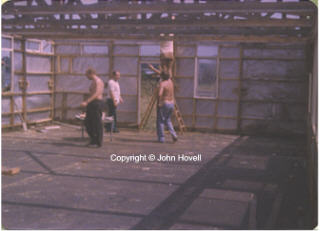 for our new
piece of land.
Over the next few years, a small dedicated team of committee
members, parents and leaders obtained planning permissions (August 1975), and procured a contractor to lay a concrete base. In
their spare time they painstakingly reconstructed the wooden
building (1976 - 1978), so that it could be continuously used as our
new HQ for the next 30 year.
for our new
piece of land.
Over the next few years, a small dedicated team of committee
members, parents and leaders obtained planning permissions (August 1975), and procured a contractor to lay a concrete base. In
their spare time they painstakingly reconstructed the wooden
building (1976 - 1978), so that it could be continuously used as our
new HQ for the next 30 year.
In 1976 our Cubs won their first District Swimming gala proudly adding our groups name to the Samways Shield. Not to be outdone, the Scouts two years later won their first District Swimming gala and added our name on the Wickham’s Shield. Since then, we have become frequent winners of the shield, in some cases winning on consecutive occasions.
In 1978 Great Amwell Scouts joined Ware and District Scout to
welcome the Queen Mother to Ware, during the re-opening of
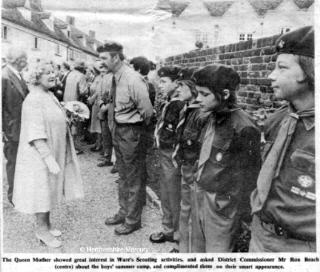 the
Blue Coat yard. Our Troop was well represented with two of our
Scouts lucky enough to have their photograph published in the local
paper. (Two Scouts in
the
Blue Coat yard. Our Troop was well represented with two of our
Scouts lucky enough to have their photograph published in the local
paper. (Two Scouts in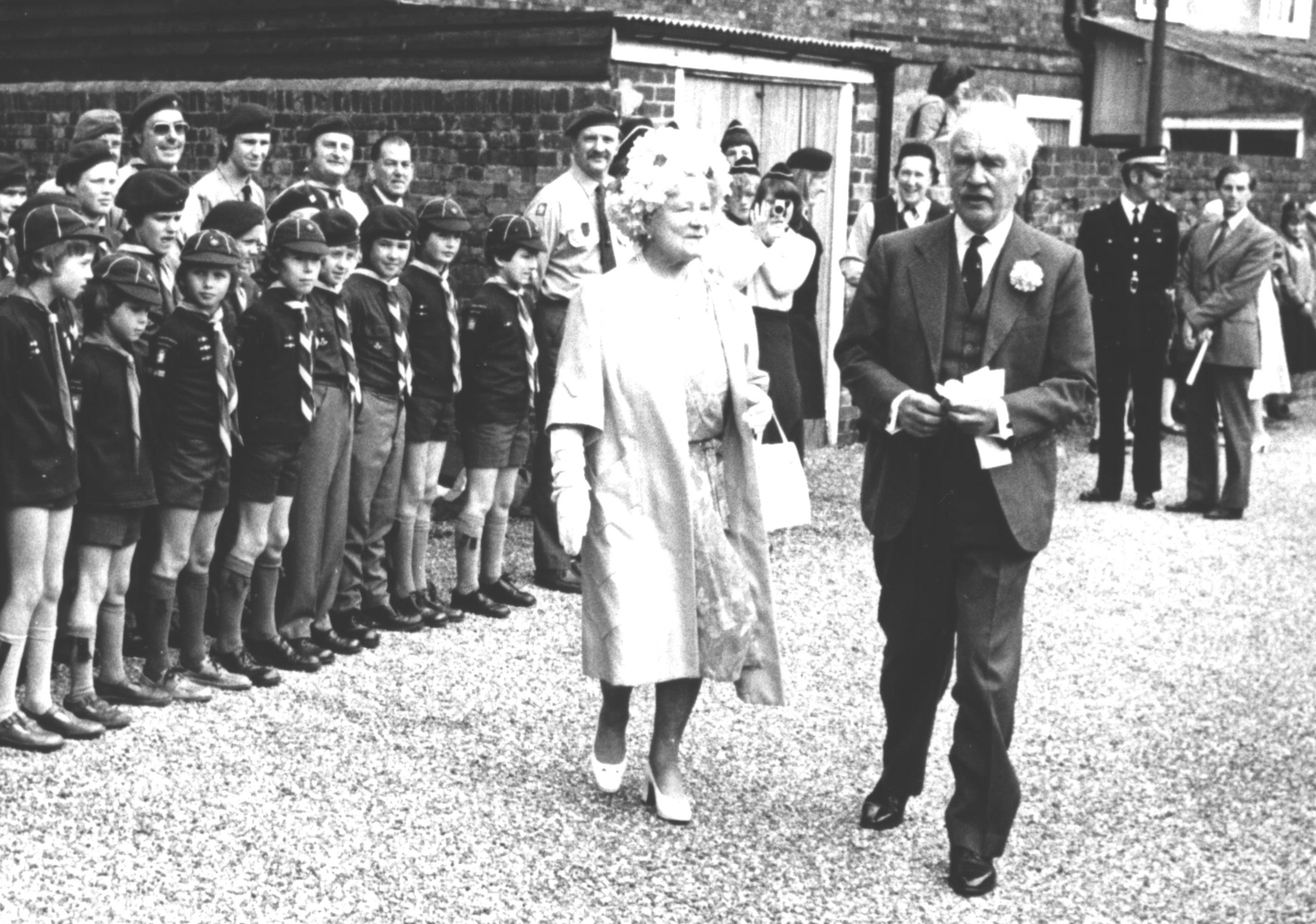 foreground).
Anthony Dakin who represented the Great Amwell leaders can be seen in
the middle of the back row (Right photo).
foreground).
Anthony Dakin who represented the Great Amwell leaders can be seen in
the middle of the back row (Right photo).
The new headquarters was officially opened on Sunday 16th September
1979 by Jim Turner (District Councillor for Hertfordshire East). A
Service of Dedication was given by
the
Revd Edward C Walker, Vicar of Great Amwell.
The Reverend
Walker had fond
memories of our group, having held the position of Group Scout
Leader between 1949 and 1959. Captain and Mrs.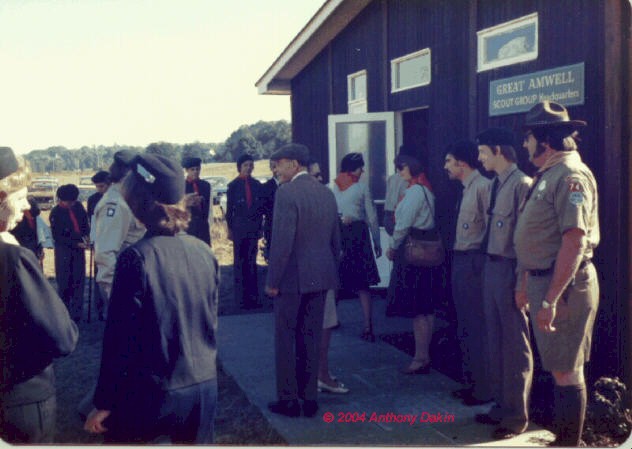 Richardson were among a large number of guests responsible for successful completion of
this project.
Richardson were among a large number of guests responsible for successful completion of
this project.
Mr Jerry Bird, Scout Leader from the USA and staying with Anthony's parents, presented Mr Whichelow with a set of Scout Badges from Anaheim, California. The Troop had developed links over the past couple of years thanks to Anthony Dakin. He attended weekly scout meetings in Anaheim, district events and helped out at weekend camps held in the California national parks, while on work secondment for 6 months.
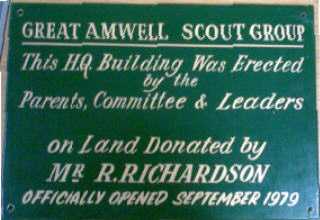
A plaque was unveiled to commemorate this momentous event and remained on display in the main hall until the old HQ was demolished in 2007. It is hoped that one day the plaque will be re-install as a reminder and tribute to Captain Richardson's generous land donation and the hard work put in by all to achieve this ambitious goal.
1980 to 2000
During the 80s and 90s, the group continued to flourish under the strong leadership of Vic Whichelow (GSL), John Hovell (Scouts) and Tony Home (Cubs). The group also had the valuable support from its assistant leaders, a well establishes and enthusiastic committee and parents.
In November 1980, the Scout leaders introduced a patrol trophy (GSL's Trophy) which would be awarded to the best patrol each term. Points were awarded for weekly inspections, smart uniform, behaviour, patrol activities and attendance. The Trophy was first awarded to Eagles Patrol (David F, Paul S, Rickie M and Geoff H) in January 1981.
In November 1980, a new monthly newsletter was launched called the “Great Amwell Scout Group Leader”. Co-edited by Neil Martin and Vic Whichelow, this replaced previous 1970s newsletters called "Amwell Scout Troop Bulletin", produce by Norman Rand in September 1970, and the "Leader" which had run for 2 years. A new edition called the “Gt Amwell Group News” was launched in December 1987. Scouts also produced their own limited edition of the “Coffee House News” (1986) and “The Amwell Informer” (1990 / 91). In February 2005 a quarterly News letter was launched by the Group Scout leader, to keep parents informed of forthcoming events. This ran for two year with the final edition being produced in October 2007, copies of which can be found in this websites in the News page.
The Scout Troop had an exciting yearly program containing basic skills, adventure, competitions, weekend treks to Wales and Derbyshire and traditional summer camps in Scotland, Wales and Devon. In 1981, John Hovell and his wife successfully led a Scout expedition to Finland (7 to 26 August). This being the first time that the Scout Troop had ventured across the sea for many years. Among the places visited were the Arctic Circle, a Copper and Zink mine, the Russian border and a day out shooting rapids
The Cub pack continued to provide boys with basic Scouting skill,
challenges and adventure. One of their memorable
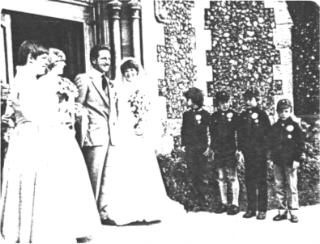 and
privileged tasks during 1982 was to form a Guard of Honour at the
wedding of Steve and Wendy Starbuck (both Assistant Cub Leaders).
and
privileged tasks during 1982 was to form a Guard of Honour at the
wedding of Steve and Wendy Starbuck (both Assistant Cub Leaders).
In March 1983 and due to the increase in popularity, an additional Cub pack (Otters) was opened and run by Pam Albany, in an attempt to reduce expanding waiting lists. Our second pack (Tigers) ran for seven years, until a leader shortage forced it to close. The Otter pack again increased to full capacity, with lads on existing waiting list, being placed with other Groups within the District.
Scouts gained 9th place overall in the annual County Green Beret Challenge in November 1987. As one of the top ten teams they automatically qualified for the Peak Assault in the following March 1988. In the group’s newsletter for December 1987, a very proud Group Scout Leader made the following comment:
“To put it mildly I’m dead ‘Chuffed’ and so pleased for the Troop and Leaders”
The following year we achieved a similar placing in the County Green Beret and once again qualified for the Peak Assault. (Photos of this occasion would be very much appreciated). The Green Beret team comprised of Toby Mollett, Simon Sadler and two other Scouts.
Also, during this period, the troop successfully nominated and sponsored Scouts for two World Jamborees. Simon Sadler attended the 16th World Jamboree in 1988 and Darren Livermore the South Korea for the 17th World Jamboree (1991).
Our first Beaver Colony was set up in 1989 following the official introduction of Beavers into the U.K in 1982. During the early 80’s, the group like others were very sceptical of its justification or benefits, and therefore strongly resisted its early introduction. Those concerns and worries soon passed after its introduction and now fully appreciate it contribution towards the group’s successes. The colony was initially led by Ellie Perkins and later supported by Teresa Penny and Enid Burton when the colony reached full capacity and waiting lists dramatically increased.
In 1990 the census returns show that the group had 24 Beavers, 25 Cubs, 23 Scouts, 9 Leaders and 6 Instructors. The group continued to be led by John Budworth (GSL), John Hovell (SL), Tony Horms (CL) and Ellie Perkins (BL). All boys were enjoying their Scouting and achieved good results in competitions and badge work.
In 1990, a new annual District Scout competition was introduced called 'The Nocturnal'. The competition comprised of scout teams navigating around the countryside, between 8-10 bases. Each base was manned by leaders who set tasks and marked each team on their Scouts skills. The event was run mainly in the Autumn and initially ran between 3am and 11pm. First year winners were 3rd Ware Bulldogs. Great Amwell 'Bulldogs' finally won the competition in 2004 and have been winners many times.
Since the start of Scouting (1907), girls have always wanted to join in with the boy scouts, doing the same exciting things. Some Girls initially set up their own troops and petrols, with others forming part of a large group with boys. These girls adapted the uniform to meet their needs (See "Timeline showing the development of Scout Uniform (1908 to the present day)" written by the Scout Heritage. section 1909 - Girl Scouts). In 1909, Girl Scouts attended a Boy Scout Rally at Chrystal Palace. At the Rally, Girls Scouts met Robert Baden Powell and informed him, that they wanted 'to do the same things as the boys'. In 1910, Robert Baden Powell formed the Girl Guides!
It wasnt until 1976 that Girls were once again allowed to joined the Scout Movement as Venture Scouts (15-20 year olds). In 1991, UK Scouts became fully mixed in all sections. On 1 January 2007, it became compulsory for all groups to ensure provisions were in place to accept girls into all sections
During 1991, a group of girls attended a number of Troop meetings following parent enquiries. Sadly, Interest dwindled at the time and it wasn’t until 2004 that girls began to attend Scouts. Since then the group have seen a dramatic increase in number of females attending Beavers, Cubs and Scout sections. Rebecca Johnson was our first girls to be invested into the Scout Troop in 2005. She later became a young leader and ASL
In 1992, Geoff Cushing a Scout parent who had been helping out in the Troop for a few months was asked to take over as Scout leader. Although Geoff was thrown in at the deep end, with very little scouting knowledge or experience, he succefully ran the Troop for 11 years.
An annual District Scout Cooking Competition was introduced in February 1996 following feedback from Scouting sections who were already running an annual competition. Great Amwell had been running an annual cooking competition since 1974. On occasions the group committee members were treated to a 3-course meal cooked by the scouts! A table suitably decorated would greet their guests in the centre of the main hall. Scouts would provide non acholic drinks, cook their food and serve when ready. All committee members survived the yearly ordeal!
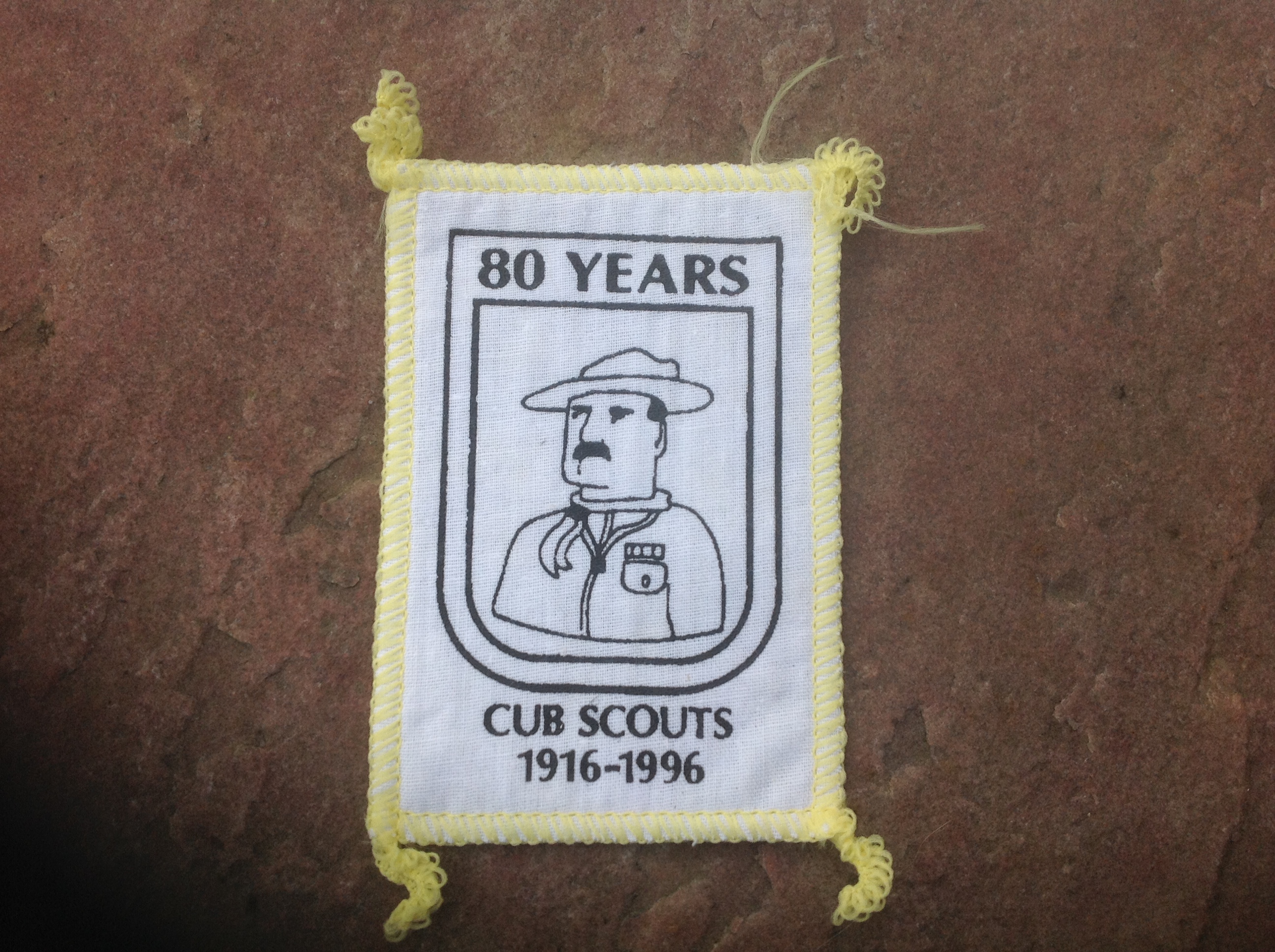
In February 1996, Alfie Smith won the District
badge competition for his unique design to celebrate the eightieth
anniversary of Cub Scouts. This badge was worn by all Cub Scouts in
the District.
The Cub pack under the leadership of Andy French (Akela), continued to perform well in the Oxley Shield, Swimming Gala, Go-Karts, (which they have managed to win for the sixth year running 1998 to 2004).
During 1999, Anthony Dakin designed and launched the group’s first
The Vic Whichelow award was first introduced in 1999 in his memory having served the group as GSL for 21 years (1972 -1993). An engraved trophy presented at the Group’s Annual General Meeting (AGM) to a young member of each section for their commitment to the weekly meetings and other organised events over the last 12 months.
2000 to 2020
The Scout association announced the new uniforms for the UK’s half a million Scouts on the 22nd February 2001. This coincided with Founder’s Day and the 144th anniversary of Baden-Powell’s birth. Beaver Scouts started to wear a new turquoise sweatshirt and Cub Scouts a dark green sweatshirt. Scouts changed to teal green smart shirt and navy-blue activity trousers, Explorer Scouts to beige shirt and navy-blue activity trousers. Adult Leaders change to a stone shirt and navy-blue trousers, skirt or activity trousers. All sections including leaders, wore the group's scarlet neckerchief.
In 2002, the Group Executive put the wheels in motion to obtain planning permission to improve and expand our headquarters. The proposals were to provide a modern and safe facility for the group and the wider local community that currently use the existing premises. Planning permission was eventually granted in January 2004.
During 2004/5 the Group submitted applications to the National Lottery in respect of funding for a new HQ. Unfortunately, these were all turned down, although a number of smaller local grants were forthcoming enabling us to continue with our ultimate Goal.
In 2005, Cubs and Scouts from both St Margaret’s and Great Amwell
were call upon
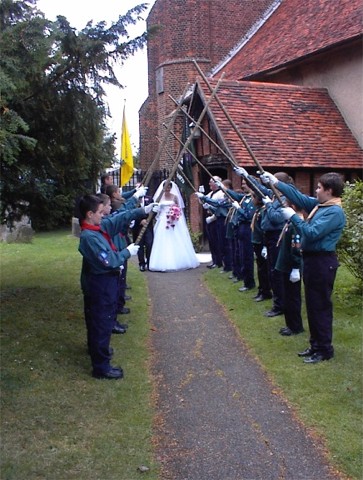 to form a Guard of Honour at the wedding of Paul and
Gail Stretch (nee Burton). Paul is a GSL at St Margaret’s and Gail
an AGSL
at Great Amwell.
to form a Guard of Honour at the wedding of Paul and
Gail Stretch (nee Burton). Paul is a GSL at St Margaret’s and Gail
an AGSL
at Great Amwell.
Over the last few years, Beavers, Cub and Scouts have done extremely well in District competitions, consistently beating their rival groups (2nd and 3rd Ware) into lower positions in some events. This is a tribute to all the leaders involved at that time and led by Stuart Baker (Beavers), Andy French (Cubs) and Rob Johnson (Scouts).
In 2007, thanks to the very generous and substantial donation from Cllr Nigel Copping, with additional donations from parents, local charities and companies our funding requirements for the initial build were reached. Building work started in July, following the demolition of our old building. Over the summer and autumn period, rapid progress was made with the structure and services completed in late December.
2007 was a busy time for the group with the new HQ build, the Scout Centenary camp at Woodhall Park and the 21st World Jamboree at Hylands Park, Chelmsford, UK in which one of our scouts was chosen and sponsored.
Prior to the Jamboree, Anthony joined the “build" team (JBT), setting up the site to accommodate 28,000 Scouts and 12,000 adult leaders from more than 150 countries. During the Jamboree (27 July to 8 August), Anthony was assigned to the Gilwell “Adventure” Off Site Team (OST), helping to look after 4000 scouts transported from the main Jamboree site every day in 60+ buses.
Our new Headquarters was officially opened by Cllr Nigel Copping, on
Sunday 13th
January 2008. Local dignitaries were in attendance together with County
and District Scout Leaders. The
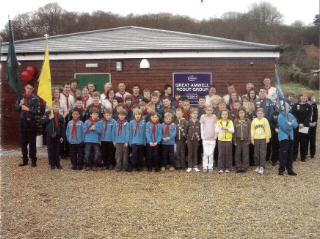 building
was blessed by the Revd Anne Donaldson from St Andrews Church,
Stanstead Abbots. The 1st
Braughing Scout Band braved the cold to entertain arriving guests
with a mixture of lively music.
building
was blessed by the Revd Anne Donaldson from St Andrews Church,
Stanstead Abbots. The 1st
Braughing Scout Band braved the cold to entertain arriving guests
with a mixture of lively music.
Our future looks rosy, with a new "Wolves" Beaver colony started in 18th February 2008 and a new "Leopards" Cub Pack opened on 7th May 2008.
Because of the overwhelming success of our two Beaver colonies and Cub packs a second Scout Troop was quickly set up. The new ALVAR Troop opened it doors on the Monday 1st November 2010 in preparation to fully accommodate the large numbers of older cub expected in 2011 and 2012. The Troop was led by Anthony Dakin (SL) and Ian Devonshire (ASL). The ALVAR troops name was chosen by the Scouts as part of their first troop forum task. The young troop was made up of a few Cubs moving up, a Scout, a Brownie Guide transfer and a couple of new members.
Although very young, the troop quickly learnt new scouting skills.
All of which allowed them to
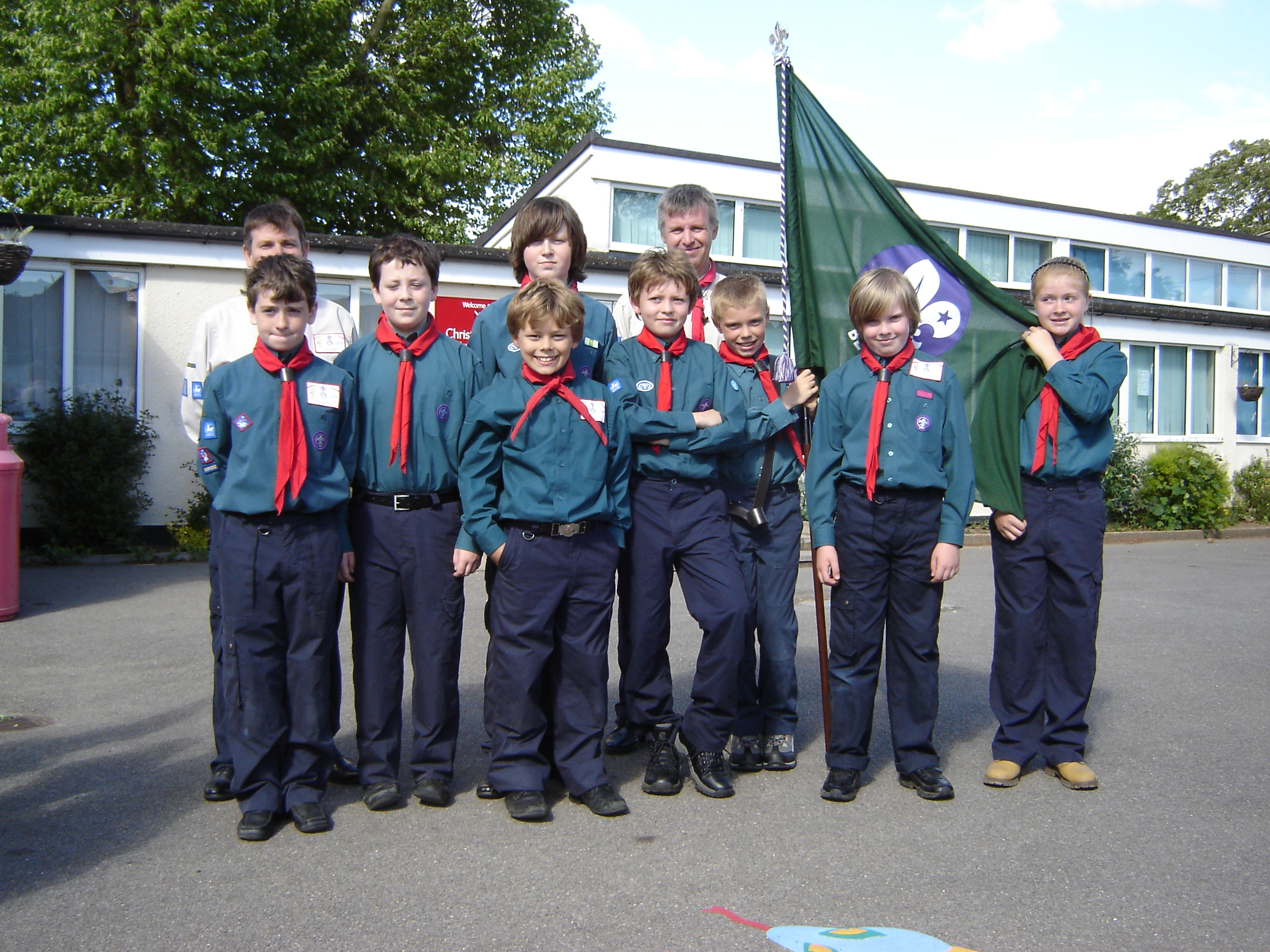 successfully participate in challenging
Camps, District Events and Competitions such as the District Cooking,
Lightweight and Heavyweight, Raft Race, Outdoor Bowls and Nocturnal. Anthony and Ian, were so impressed with the teamwork
shown during the Raft race.
successfully participate in challenging
Camps, District Events and Competitions such as the District Cooking,
Lightweight and Heavyweight, Raft Race, Outdoor Bowls and Nocturnal. Anthony and Ian, were so impressed with the teamwork
shown during the Raft race.
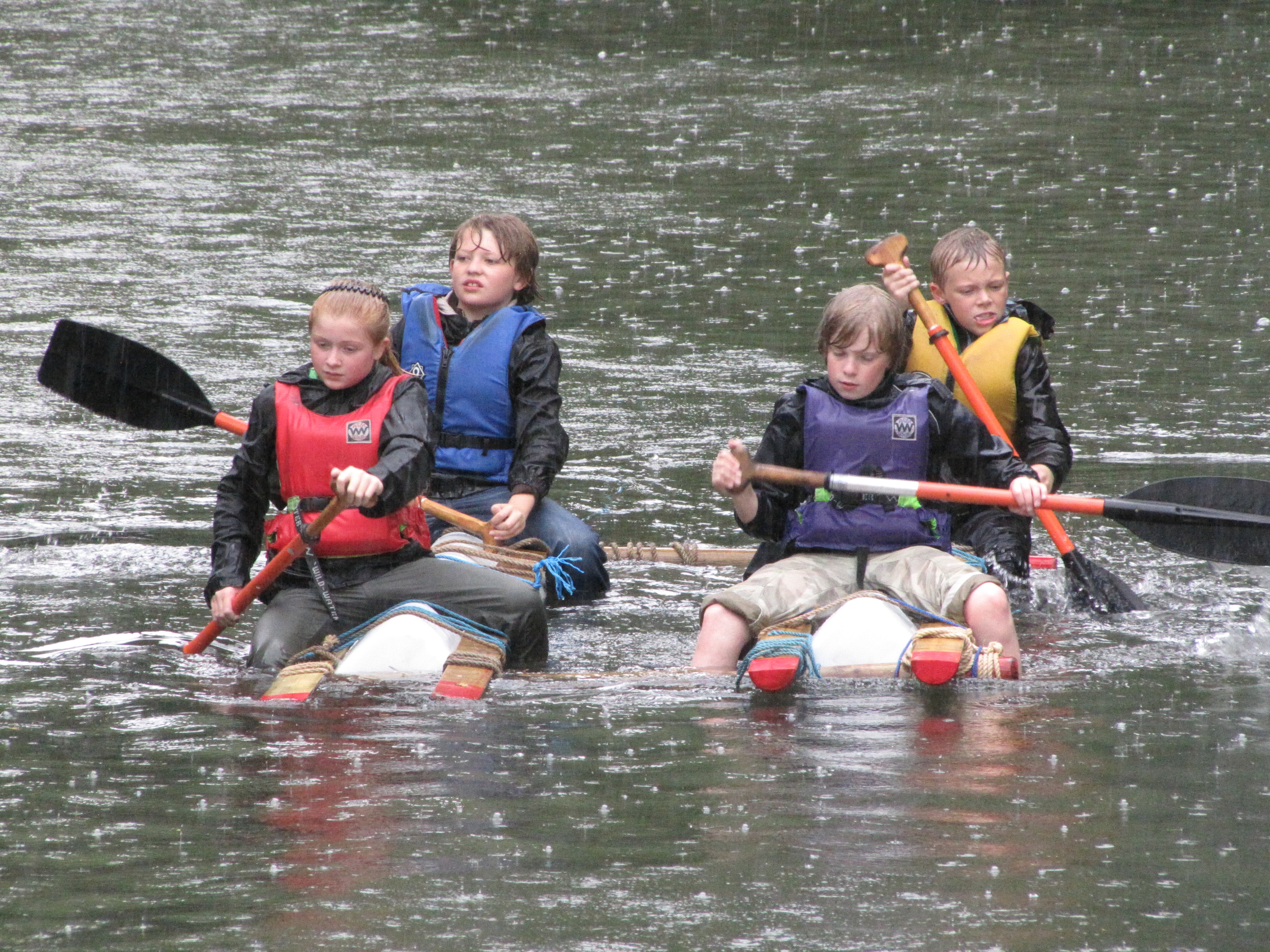 The
Scout carefully assembled the raft in the pooring rain making sure
that the lashings and knots were neat and tight. The raft remained
intact throughout the race. If this
raft had been used on the original 3 mile race between Hertford to Ware, it would have
also survived
fully intact.
The
Scout carefully assembled the raft in the pooring rain making sure
that the lashings and knots were neat and tight. The raft remained
intact throughout the race. If this
raft had been used on the original 3 mile race between Hertford to Ware, it would have
also survived
fully intact.
In January 2012 and due to the falling numbers of older Cubs wishing to move up into the Monday and Friday Troops, the two were amalgamate into one. Scouts who were unable to attend the Friday Troop due to other commitments, were offered places at the newly formed 3rd Ware Lynx Scout Troop. Hopefully this is a temporary measure until Cub numbers increase over the next few years and we can return to our two troops.
In July 2012, Anthony introduced the new Online Scout Manager (OSM) system, diligently transferring all Scouting records from his spreadsheet. OSM is used to recording contact information, attendance monitoring, weekly program information and badge work within the Troop. In the first 6 months, the system dramatically reduced the amount of admin work and effort needed to support our busy Scout Troop. This he then rolled out OSM to all Great Amwell sections, giving detailed presentations and training to the Group Executive and Section leaders (Oct 2012). Later he introduced OSM My.Scout web portal so that parents could view and update their child’s information, monitor badgework, view program and sign up to events.
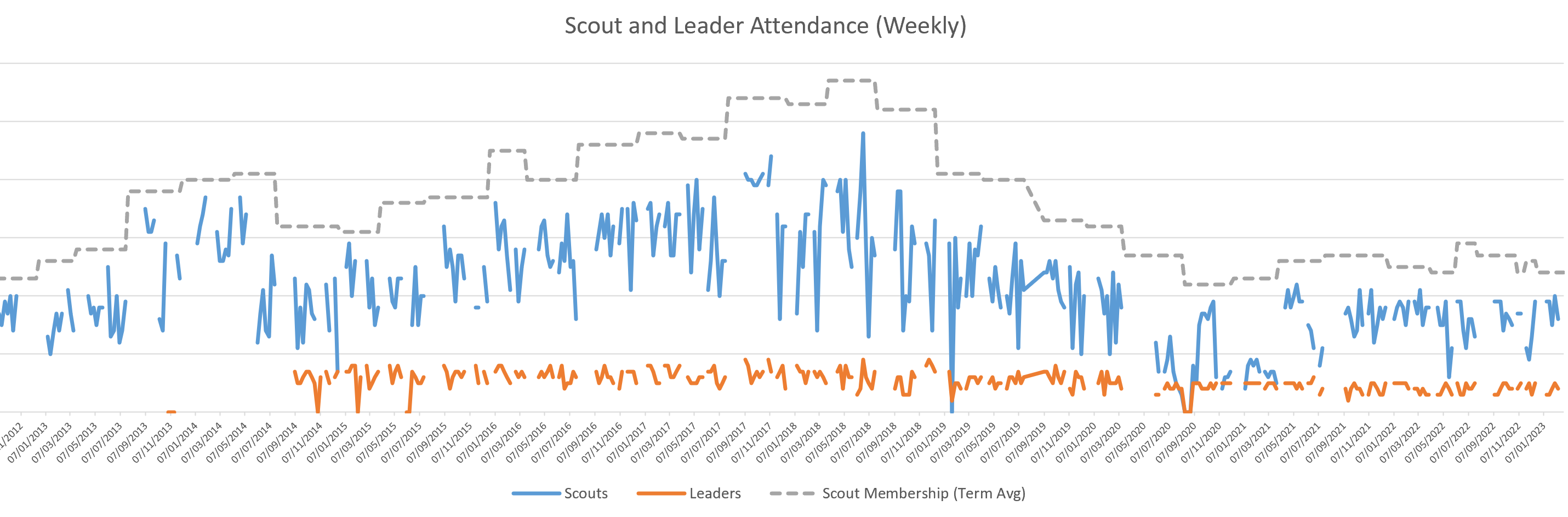
Over the last 12 years scout membership numbers and weekly attendance have fluctuated as a normal trend. During 2018, the Scout troop peaked at 57, with average weekly attendance of 30 Scouts and 6 leaders (see graph below). It became normal to utilise the patrol system and offer a 3 weekly rotation program, so that leaders could provide a more personalised experience for Scouts
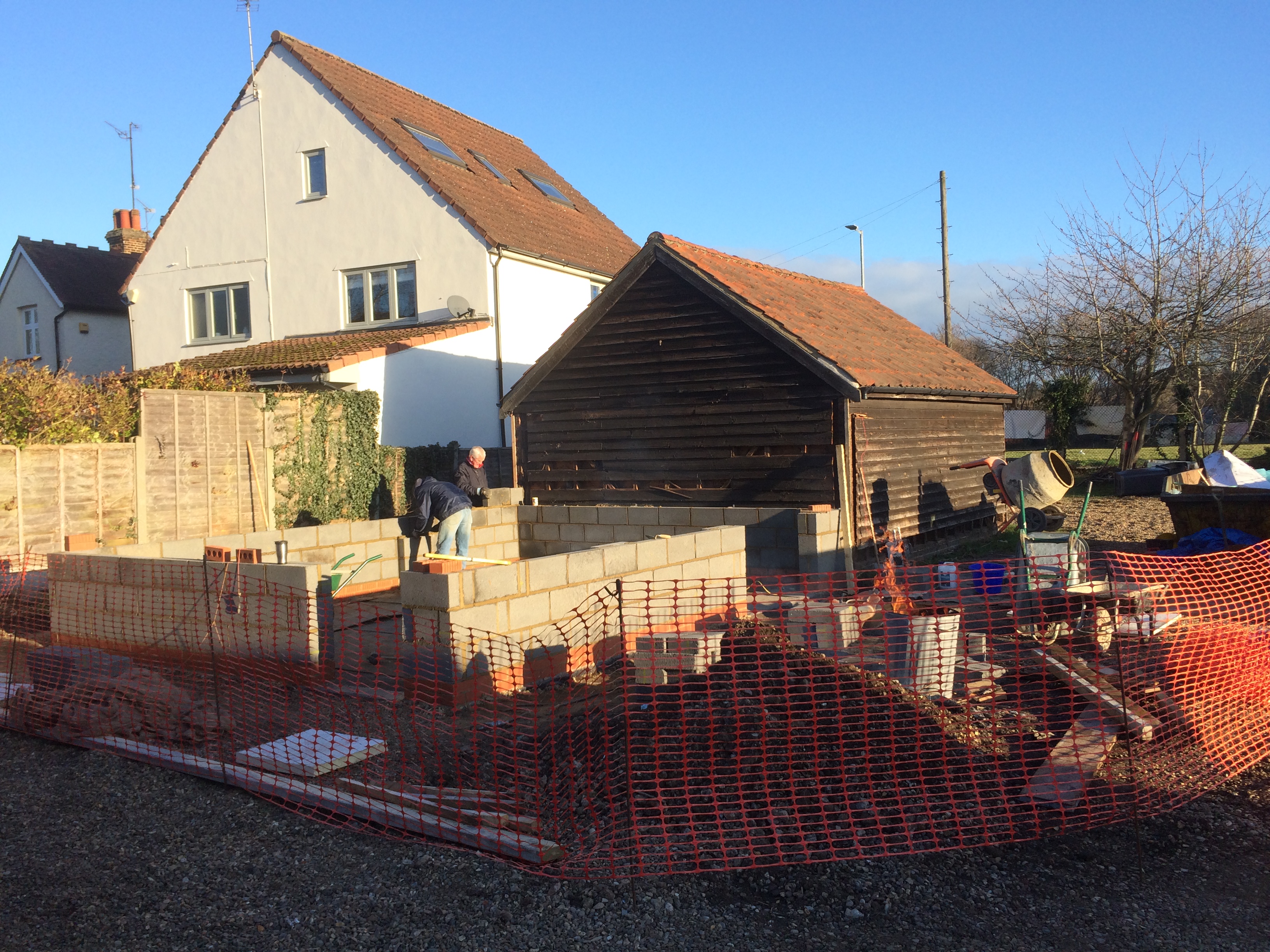
To help cater for increasing Scouting numbers and external booking potential, the group executive enbarked on an exciting expansion plan. Starting in November 2017 with the Kinja hut refurbishment and extension.
%20-%20Copy.PNG)
In July/Aug 2019, Daniel B join the Hertfordshire contingent at the 24 World Jamboree in West Virgina, USA.
2020 to 2040
2020 was a very challenging time for everyone and sadly remembered for the closure of all UK Scouts due to COVID lockdown on the 17 March 2020. In line with government guidelines and youth sector provision, Scouting adopted a four-stage readiness system. [RED: No face-to-face Scouting meetings or activities, no residential experiences, solely digital programme delivery. AMBER: Digital programme delivery and some outdoor activities with restricted group size, no residential experiences. YELLOW: Digital programme delivery continues, restrictions on group sizes indoors and outdoors, no residentials. GREEN: All activities will resume in line with Government guidance].
Leaders soon adapted and excelled in mastering online Zoom meetings, whiteboards, screen sharing, muting participants, breakout rooms and online investitures. Leaders organised weekly challenges, badgework initiatives, competitions and many cooking projects. The Scout section completed 29 weekly Zoom sessions between June 2020 and March 2021.
When restrictions briefly relaxed to AMBER readiness level on the 6 July 2020, scout groups were allowed to organise COVID safe face-to-face outdoor activities up to a maximum group size of 15 (including Leaders). No young person or adult volunteer could move between different groups of 15 on the same day. Before doing so, each Scout section had to submit a comprehensive COVID Risk Assessment document (normally 5 pages per section) for Group Executive and District approval.
On the 5 November 2020, Scouts and other youth activities returned to RED readiness level. This meant that they could no longer be any face-to-face activity with young people or adult volunteers. Only online meetings could be delivered.
A month later (2nd December 2020), the Scout Association confirmed that Beavers, Cubs, Scouts and Explorer sections were returning to AMBER readiness level. Exception being the Scout Network which remains at the RED readiness level. A slight relaxing of AMBER rules, being a group size of up to 15 young people (aged under 18), plus 5 adults. The session could take place outdoors or indoors, but must still be socially distanced. Face coverings needed to be worn by anyone of Scout-age (11+) when indoors, unless exempt. Adults delivering an activity to young people were not required to wear a face covering. Previous AMBER level, and approved Covid Restart Risk Assessments would still be valid, unless there has been a material change to how sections were operating.
In the new year (7th January 2021), the Scout Association confirmed that most of the UK was returning to RED readiness level until further notice. Therefore, no face-to-face activity could take place with young people or adults
From 29 March 2021, Scouts move to AMBER readiness level, with Groups allowed to meet outdoors in group sizes of 15 plus leaders (5 maximum). From 12 April 2012, both outdoors and indoors meetings will be allowed in group sizes of 15 plus leaders (5 maximum).
On the 6 September 2021, the UK government finally confirmed youth sector provision in England would move to GREEN and allowing all Scouting activities to resume in line with Government guidance
This announcement was closely followed by the UK Scout Association launching its Squirrels program for children aged four to six years (9 September 2021). Prior to the launch and pre COVID, the Scout Association had run various piloted programs to test various teaching models and ideas.
Our first Squirrels section, called Forest Dray was opened on the 30 October 2023 and has already become very popular. It is hoped that it won’t be too long before we welcome a second Squirrels section into the group.
In January 2023 and 2024, four scouts won the District Cooking Competition. This entitled them to attend the County Cooking Competition in which they were runners up in 2023 (2024 results unknown). In 2025, four new scouts came second in the District and attended the County CC where they took second place. In 2026, 4 scouts attended the County Cooking Competition and came took firts place.
In April 2023, work started on connecting the Scout HQ to the mains sewer on London Road. Previously we had relied on an 1970s underground septic tank and weekly pump out service.
Alex attended the 25th World Scout Jamboree in South Korear (August 2023).
In 2023, the Scout association anounced its new vision. By 2025 we'll have prepared more young people with skills for life, supported by amazing volunteers that deliver an inspiring programme. We'll be growing, more inclusive, shaped by young people and making a bigger impact in our communities.
As part of the vision, a uniform review for the Scout sections, Explorers and Adult leaders would take place. At the end of 2024, UK Scouts anounced that the Scout Section uniform would become more flexable, practical and affordable. Some changes to the styling and fit with a range of informal wear, available during 2025.
In February 2024, work began on a side canopy extension, which will be used for outdoor activities during wet weather periods.
The future
Perhaps one day we will have our own Explorer Scouts section, allowing 1st Great Amwell to cover for all age ranges. This will obviously depend on the number of older Scouts requiring placement and our ability to attract additional qualified Explorer leader resource.
Researched and written by Anthony Dakin ©
All work is Copyright and may not be reproduced in full or part without the authors written permission.
Author note: There is still a lot of further research to complete, which will be added in the next instalment. If you have any new or additional information or photographs relating to the group’s history, I would be pleased to hear from you.
v.1052 - Feb 2026
Acknowledgements:
I am particularly indebted to Norman Vines, Tony Burgess, Michael Jennings, Alan Reynolds, the Revd John Ironside and Christopher Thomas Gill Leech. All of which have shared their Sea Scouting experiences and photographs, so as to provide a better understanding of the group’s early history. They have also spent many hours of their free time reviewing the various drafts of this document, searching for additional information and providing prompt feedback and support throughout.
I would also like to thank Frank Brittain our County Archivist for firstly taking care of deposited documents and secondly for giving his time to assist me with my research project.
I also owe a huge thank you to John Hovel, Silvia Hovel, Andrew Whichelow, Jean Whichelow, Jan Bush, Hazel Dorrington, Jean Glasscock, Rob Johnson, Marian Waller, Andy French and my parents for their help. They have kindly provided important documents and photographs over the years, so as to build up a clear picture of our committee and group activities.
I also thank Patricia Styles from the Archives department at Gilwell Park for her help in reviewing the leader details and providing additional information relevant to our Group.